
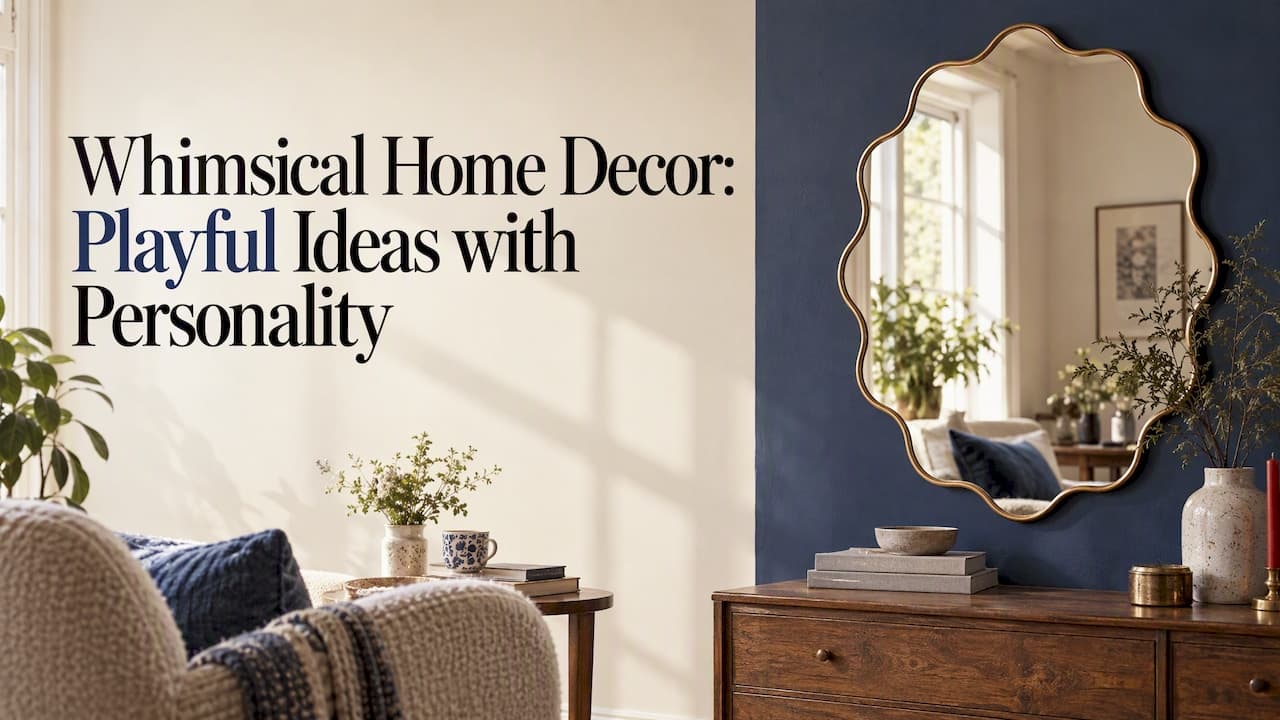
Whimsical home decor is any decorating choice that makes you smile: a scalloped edge, a surprising colour, a glowing little scene tucked into a bookshelf. You don’t need a new style or a big budget. Pick one or two playful pieces, give them room to stand out, and let the rest of the room stay calm around them. Below you’ll find how the look works, which details earn their place, how to use it room by room and how to choose whimsical pieces as gifts.
TL;DR
-
Whimsy is about surprise and joy rather than rules. Bold colour, pattern, irregular shapes and quirky accessories are the usual ingredients.
-
Small accessories are the easiest way in: a wavy candlestick, a hand-painted vase or a light-up book nook can lift a neutral room.
-
Keep one confident focal piece per zone, and balance it with calmer finishes so the room feels grown-up rather than nursery-like.
-
Function still matters. The best whimsical rooms work as well as they delight.
-
For gifts, choose something with a story, a use and a bit of personality that suits the person, not just the room.
Table of Contents
What whimsical home decor really means
Whimsy is hard to pin to a single look because it is a mood. Homes & Gardens describes the key elements as bold colours, eye-catching patterns, irregular shapes and quirky accessories. What links them is a lighthearted, slightly unpredictable feel.
That makes it different from, say, minimalism or strict traditional schemes. Minimalism edits things out. Whimsy deliberately lets in the unexpected: the mismatched chair, the ceiling that isn’t plain white, the ornament that makes a guest stop and ask where it came from.
Designers are fairly relaxed about it. In House & Garden, Chloe Willis of Sibyl Colefax & John Fowler says a bit of surprise, something jarring or magical, can be delightful, and that function alone doesn’t make you smile the way whimsy does. Better Homes & Gardens puts it similarly in its 2026 piece on the Year of Whimsy: it is a personal process with no secret formula, and anything that sparks joy is fair game.
The practical takeaway is freeing. You are not trying to match a template. You are collecting things you love and arranging them with a light touch.
Whimsical versus childish
The worry most people have is that playful will tip into childish. The difference is usually intention. Whimsy that feels grown-up is chosen with care: good materials, a considered palette, and pieces that have craft behind them. Childish tends to happen when everything is playful at once and nothing is allowed to be quiet. We come back to this in the section on avoiding clutter.
Start with colour, pattern and wallpaper
If you want the biggest change for the least fuss, start with the surfaces. Walls and soft furnishings set the tone before a single ornament goes on a shelf.
Colour
Homes & Gardens suggests that sugary-sweet pastels on walls or accessories can bring a playful feel, and its February 2026 guide to making a home more whimsical adds that pops of unexpected, bolder colour work too. You don’t have to repaint a whole room. A single colour you wouldn’t normally choose, in a cushion, a vase or a lampshade, does the job.
Wallpaper
The same guide identifies wallpaper as one of the easiest ways to introduce whimsy, with experts suggesting fun prints in surprising places such as ceilings. If a full room feels like a commitment, think small: the back of a bookcase, inside a wardrobe, a downstairs cloakroom or the inside of a cupboard door. Rented homes can use removable options, though check your tenancy agreement first.
Pattern
Whimsical rooms are rarely matched. Homes & Gardens points to florals, checks, stripes, geometrics and animal prints as possibilities, and the general idea is to mix them. A useful rule is to repeat a colour across different patterns, so that a striped cushion, a floral curtain and a checked throw feel related even though none of them match. Keep a mix of scales as well: one large pattern, one medium, one small.
Shapes and small details that carry the look
Pattern and colour are only half the story. The other half is form. Goodhomes Magazine highlights sculptural details such as wiggles, scallops and bobbin shapes, plus accessories like lava lamps, humorous salt and pepper shakers and wavy candlesticks.
These are good places to start because they are low risk. A scalloped mirror or a wavy candlestick sits happily in a neutral room and gives it a focal point.

Candles and light
Light is where whimsy often feels most magical. Candle holders with a bit of sparkle, or pieces that cast an unusual glow, change the mood of a room in the evening. Our Crystal Trio Candle Holder is a good example of how a single sparkling piece can act as the centrepiece of a mantelpiece or sideboard.
Vases and handmade finishes
A vase doesn’t need flowers to do its work. Hand-finished pieces with a visible artisan touch bring character that mass-produced ones can’t. The Artisan Flower Wax-Resist Vase is the kind of piece that works on a windowsill, a bookshelf or a dining table, with or without stems.

Storybook touches
Better Homes & Gardens notes that the 2026 whimsy trend is about intentional choices, such as storybook-inspired details or meaningful decor, rather than simply filling a room. That is where fantasy-inspired pieces fit well. Our Glowing Wizard Book Nook and Bookend slips between books and adds a small lit scene to a shelf, which suits anyone who likes a hint of fantasy without a full theme.
Whimsical decor, room by room
Whimsy has to coexist with real life. In House & Garden, Brandon Schubert warns that it shouldn’t come at the sacrifice of function or of using a space normally. With that in mind, here is how it can work in different rooms.
Living room
The living room usually has the most neutral base, which makes it ideal for one or two playful statements. Think of a sculptural lamp, a set of mismatched cushions, a gallery wall of witty prints or a mantelpiece styled with candles and a few oddities. Homes & Gardens suggests contrasting patterned wallpapers with vintage treasures, novel photo frames or unique light fixtures to give a lived-in look.
Bedroom
Bedrooms benefit from softer whimsy. Choose gentle colour, layered textiles and warm light rather than anything loud. A playful bedside lamp, a patterned throw and a small shelf of treasured objects will do more than a themed wall. If you like a calm ritual before sleep, our guide to a cosy night in on a budget has ideas that sit well with this softer approach.
Kitchen and dining
Kitchens are full of small objects, so humour is easy to add. Goodhomes mentions humorous salt and pepper shakers and playful hooks. House & Garden gives turrets and finials added to kitchen cabinetry as a more architectural example, and describes trompe l’oeil as having whimsical merit. For most of us, a colourful teapot, a quirky tea tin or a hand-painted vase on the table is the practical equivalent.
Reading corners and shelves
Bookshelves are natural places for whimsy because they already display what you love. A tiny scene between volumes, a unique bookend or a lamp with a soft glow turns a shelf into a feature. If space is tight, our small reading nook ideas show how to make a corner feel inviting without rearranging the whole room. You can also browse our Bookish collection for pieces made for readers.
Desk and workspace
A home office can look sterile. A cheerful desk pad, a pretty candle or a small plant makes a working day feel friendlier. Our Cosy Cat Weekly Desk Planner is an easy way to add personality to a desk and keep the week in order at the same time.
Seasonal moments
Whimsy also suits the festive season, when people are already happy to bring in the extra sparkle. A single storybook ornament, such as our 3D Fairy Tale Planet Ornament, can stay on display as a small piece of decor rather than being put away with the tree.
Keeping whimsy charming, not cluttered
This is where most rooms go wrong. A playful room can feel joyful or chaotic, and the difference is editing.
-
Anchor the scheme with one confident piece. Goodhomes Magazine suggests anchoring an unserious scheme with one confident accessory, or confining bold prints to a single zone.
-
Balance playful with grown-up. The same article says that mixing playful elements with more mature finishes helps avoid a nursery effect. Think brass, wood, linen and glass alongside the fun pieces.
-
Leave some pieces room to breathe. Better Homes & Gardens advises not going too far with whimsical details so that a magical piece can stand out, since too many can feel less special.
-
Choose things with meaning. A piece you picked because it reminds you of a book, a trip or a person will always look more intentional than something bought to fill a gap.
-
Dial it up and down. Designer Martin Brudnizki says in House & Garden that whimsy can be turned up or down. A hallway can be bold while the bedroom stays gentle.
A simple test: stand in the doorway and ask what your eye lands on first. If the answer is one delightful thing, you’ve got it right. If it can’t decide, remove two items.
Our perspective
We think whimsy is simply what happens when a home stops trying to look like a catalogue and starts looking like the people who live in it.
That is why we choose pieces for Kotoisa with both feeling and function in mind. A hand-painted 3D book nook should make you smile every time you pass the shelf, but it should also sit neatly between your books. A vase should be lovely empty and lovelier full. A tea should be as colourful in the cup as it is on the tin.
Our approach is to curate rather than to pile on. One well-chosen, distinctive piece will do more for a room than ten generic ones, and it is much easier to live with. If you are unsure where to start, begin with something small that belongs to a ritual you already have: your evening reading, your cup of tea, the candle you light when the day ends.
Whimsy shouldn’t feel like effort. It should feel like a little bit of joy that you notice every day.
Lisa
Choosing whimsical decor as a gift
Whimsical pieces make lovely gifts because they are personal by nature. They say, I know what makes you smile. A few things help you choose well.
-
Think about the person, not the room. You may not know their colour scheme, but you probably know whether they love books, tea, cats, candlelight or fantasy. Match the piece to the interest.
-
Pick something with a use. A vase, a candle holder, a planner or a bookend gets used, which means it keeps being enjoyed.
-
Go small and distinctive. Smaller pieces fit into any home and carry less risk of clashing. They also tend to be easier to post or wrap.
-
Look for craft and character. Hand-painted or artisan-style finishes feel more thoughtful than something you could find on any high street.
-
Consider a theme or bundle. A candle, a journal and a tea make a good set for someone who needs a quiet evening. Our Cosy Finds We Love page is a helpful place to see a few ideas together.
-
Keep it light-hearted when it fits. For friends with a sense of humour, our funny and unique gifts are designed to raise a smile.
If you are gifting to someone who prefers a very minimal home, choose one lovely thing rather than several. Whimsy works well in small doses.
Find your whimsical pieces at Kotoisa
We curate homeware and gifts that add comfort and a touch of charm to everyday living, from book nooks and artisan vases to candles, journals and specialty teas. Everything is chosen for its design and its usefulness, so it suits a home as well as a gift box.

Browse the full range on our Kotoisa homepage, or head straight to the Bookish collection if you are shopping for a reader. For a calm centrepiece, take a look at the Calm Corner Zen Garden Candle Set.
FAQ
What is the easiest way to add whimsy to a home?
Start with a small accessory. Goodhomes Magazine suggests wavy candlesticks, humorous salt and pepper shakers or playful hooks as low-commitment ways to try the look. One piece in a neutral room is enough to change how it feels.
How do I stop whimsical decor looking childish?
Keep the playful elements to one focal point or one zone, and balance them with calmer, grown-up finishes. Choose well-made pieces in a considered palette rather than themed items everywhere. Space around each piece helps it look intentional.
Can I use whimsical decor in a small room?
Yes. Small rooms suit small gestures: a patterned cushion, a lit book nook on a shelf, a pretty candle holder. Choose one standout piece instead of several, and keep surfaces uncluttered so the room still works for everyday use.
What colours work for a whimsical look?
Pastels, bright accents and unexpected combinations are all common choices. Homes & Gardens mentions sugary pastels and pops of bolder colour. Repeat one or two colours across the room so the mix feels connected.
Is whimsical decor a passing trend?
Some publications call 2026 the Year of Whimsy, but designers describe it as a personal approach rather than a fixed look. Katie Kiser told Homes & Gardens that whimsy is not a trend but a way of life. If you choose pieces you love, they should stay relevant to you.
Sources
-
Whimsical decor trend: how to get the playful style at home, Homes & Gardens
-
5 designer-approved ways to make your home feel more whimsical, Homes & Gardens
-
Groovy interiors: how to get the playful look in your home, Goodhomes Magazine